-2-75x54.png)
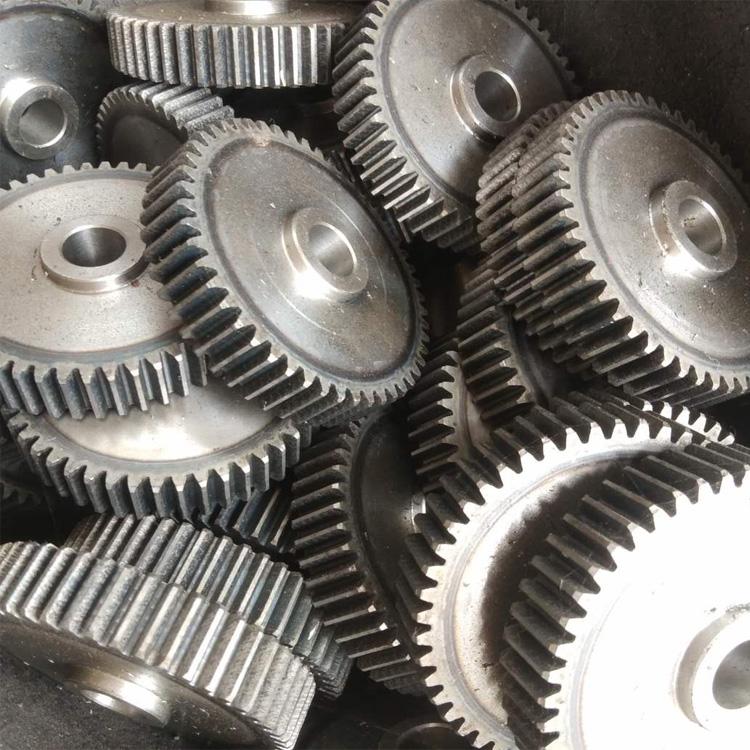
Spur gears are among the most commonly used gears in actual production and application. Damage during service is inevitable, which requires manufacturing a new gear identical to the original one. For various reasons, customers are often unable to provide drawings of the required spur gears. To ensure the machined product functions properly, accurate measurement and mapping of the gear must be carried out. Gear measurement and mapping is a complex task. Since there is limited literature introducing the measurement and mapping of spur gears, it is inconvenient to refer to relevant materials. Based on practical operation, this paper summarizes several practical experiences and methods for measuring and mapping spur gears in production, which are introduced as follows:
First, although spur gears have many parameters and dimensions, various gear standard systems specify that the module or diametral pitch shall be used as the basis for calculating other parameters and dimensions. Therefore, every effort must be made to accurately determine the module or diametral pitch during measurement and mapping. At the same time, the pressure angle is a basic parameter for determining the tooth profile, so its accurate determination is equally important.
Second, we need to understand the application conditions and country of origin of the gear to be measured, so that we can estimate the standard system adopted by the gear. Generally, China, Japan, Germany, France and the Czech Republic adopt the module system. The tooth profile can also be observed: if the tooth profile is curved and the tooth space bottom is narrow and arc-shaped, it can be preliminarily determined as the module system, with a standard pressure angle mostly of 20 degrees. The United States and the United Kingdom adopt the diametral pitch system, with standard pressure angles of 14.5 degrees and 20 degrees. If the tooth profile is relatively straight and the tooth space bottom is wide with a small arc, it can be preliminarily determined as the diametral pitch system with a pressure angle of 14.5 degrees. A gear hob or standard rack sample can also be used for comparison to identify the pressure angle. With the above information understood, actual measurement and mapping can be performed.